Yesterday evening we received the notification that a letter from the Canadian embassy is awaiting us for pick-up at the post office today February 28th. Very nice coincidence considering that we started this whole adventure exactly a year ago when we sent our application for a Quebec selection certificate on February 28th, 2005! I can't wait to see our visas apposed on our passports this evening.
Tuesday, February 28, 2006


Tuesday, February 14, 2006
We've got a date
Reservations are made. We leave from Barcelona on June 28th on an Air Canada flight to Montreal via Paris.
Our Passports went on a trip
A quick photosession, ran to DHL, measured the ID pics - too small! Back to the photographer, got yelled at because what we needed was not standard, new pics (for free and correct size this time), ran back to DHL, stuffed passports, declaration and ID pics in the envelope, wallet 30 Euros lighter... and they're sent.
That was our evening yesterday. Now we just have to wait until they send us back some nice visas!
Monday, February 13, 2006
"Nous sommes prêts à emêttre vos visas..."
This noon we finally got the big surprise in the mailbox, that famous brown envelope from the Paris embassy. Our application was accepted and our visas are ready to be issued. 350 days exactly after we started this adventure by sending out our application for a Quebec selection certificate. Now we have to get some more photos done, send them with our passports to Paris and wait for them to be returned with our visas! It's a good feeling, knowing that everything is OK and that we can now start to really prepare our move.
Monday, February 06, 2006

Wednesday, February 01, 2006
Now I am starting to bug them a bit
It's quite hard waiting, waiting, waiting... It's been over three months now that we have done the medicals and a decision should be just around the corner. But I don't like sitting around and doing nothing so I sent a fax to the Paris embassy yesterday to request an update about the status of our visa application. Let's see if they answer anytime soon.
Monday, January 09, 2006
No news is good news?
... I would have preferred to get some news from the embassy today - nothing! Empty mailbox, no e-mail, no fax, no phonecall... the wait goes on.
Wednesday, December 28, 2005
The big silence
Ever since we did our medicals back in October it has been the big silence from the Paris embassy. Even though I saw on the Forum Immigrer that some people who have passed the medicals on the same day or right after us already received their notification letter I guess we will have to be patient a bit longer. The application status on the CIC Site still shows "in process" - my hope is that it will change to "decision taken" on January 9th!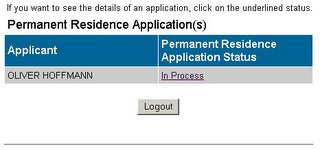
Wednesday, October 26, 2005
RPRF paid
This morning I went to my bank to make a wire transfer to the embassy to pay the right of permanent resident fee (RPRF) which must be paid before the immigrant visa is issued or before the applicant becomes a permanent resident in Canada. For my wife and me we had to pay 1380 Euros, it's CAD $975 per person as you can see on the CIC Canada Fee Schedule Page. The corresponding amounts in Euro for those who apply like us through the Paris embassy can be found at the embassy's immigration fees page.
The immigration service asked me to submit some additional information as well and now that I have posted everything the waiting can go on.
Monday, October 24, 2005
Some vocabulary and expressions from Quebec
Just found this French blog, I'll have to take a closer look when I have some more time: L'immigration au Quebec d'une tite francaise!
Friday, October 21, 2005
Another step done: medicals passed
So last week Friday my wife passed the medical examination and I did mine before yesterday. Everything more or less alright except my wife had a urinary infection that she wasn't aware about so we'll probably receive a request for additional exams for her from the embassy. The actual examination consisted of a long questionnaire and then the doctor looked at things like eye-sight, anatomy, hearing, heart condition and all the usual stuff that is being done during a medical check-up. It took about one and a half hours for each of us plus we had to do the blood analysis and chest x-ray in two different labs. We're happy that this is done now and go into another waiting period...
Monday, October 03, 2005
This goes soooo fast!
Today we already received the instructions for the medical examination, about two months earlier than we anticipated. Probably we'll have our permanent resident visas by December.
Thursday, September 29, 2005
Small centres will benefit from immigrant influx
Another interesting article at TheStar.com:
- the writer concludes: "Let's make sure that plan stays on track."
Existing studies show immigrants who settle in smaller places experience labour market advantages over those in the larger gateway cities.
In British Columbia, for example, recent immigrant men who settled outside the large cities earned several thousand dollars more annually than their urban counterparts in
Vancouver or Victoria. In addition, the labour force participation rates of newcomers in non-metropolitan areas are similar to those of locals and higher than those of immigrants in Vancouver or Victoria.
A final interesting component of Volpe's proposal is that he wants to "put in place a process that allows for the integration process to begin at the moment an application is deemed to be ready."
This component of Volpe's plan should include foreign credential recognition, job search and settlement assistance. When immigrants can apply their skills and receive decent wages on the day they arrive in Canada, they will not have to rely on the low-wage labour market of large cities as a survival strategy.
Instead, they will have greater flexibility of settling in a wider range of communities.
- the writer concludes: "Let's make sure that plan stays on track."
Monday, September 26, 2005
Immigration overhaul
Ottawa announces overhaul of the current immigration system.
Read the full National Post article here.
More details can be found in this Globe & Mail article:
Canada's current immigration levels would rise 40 per cent within five years under a plan that will soon be presented to the federal cabinet, The Canadian Press has learned.
Prime Minister Paul Martin described immigration in a speech this week as key to Canada's economic success in an era defined by low birth rates, an aging population and an ever-deepening shortage of skilled workers.
Read the full National Post article here.
More details can be found in this Globe & Mail article:
(Immigration Minister Joe Volpe) said his department has focused on five themes: Increasing the overall numbers. Providing better service both in bringing in immigrants and issuing visas. Matching immigrants with jobs needed to fill gaps in local markets. That also means allowing potential immigrants to get matching credentials in Canada before they apply, or before they are accepted. Regionalizing so that areas outside major centres can recruit people they need. Mr. Volpe said that many communities envy the numbers that head to Toronto, because they see it as a “wealth-creation dynamic.” Keeping people who are already in Canada, for example by making it easier for people with student visas to stay after they graduate.
Federal AR
Today we had a nice surprise in our mailbox: the letter from the embassy acknowledging receipt of our application has arrived. It seems that everything is OK and a file was opened. Within the next three months we should receive instructions for the medical visit.
Friday, September 16, 2005
New MICC guide "Apprendre le Quebec"
It seems that this new guide helping to prepare for a new life in Quebec is only available in French. Just a bookmark to this PDF so I don't forget reading it.
Tuesday, September 13, 2005
Canada ranks second behind Australia as world's favorite nation brand
This Anholt-GMI Nation Brands Index ranks power and appeal of 25 Nations:
The second quarterly NBI report analyzes the brand values of more countries (25 compared to 11) than the first report published in May 2005. Australia, a new entry in the NBI, has replaced Sweden as the world’s strongest nation brand.
Canada is ranked number two, Switzerland three and the UK is fourth, with Sweden fifth. Overall, the U.S. is now eleventh, rather than fourth; Russia and Turkey remain at the bottom of the overall ranking at 24th and 25th, respectively.
Tuesday, September 06, 2005
Canada not all about Mounties, mountains and moose?
To some this might be surprising, but Canada has more to offer than Mounties, mountains and moose.
Ontario immigration funding
The Star has an article about Ontario's struggle to obtain federal funding to help immigrants find employment, get language training, move into an apartment or upgrade their qualifications. Read full article here
Quebec's housing affordability improves
RBC's analysis suggests that housing affordability in Quebec is improving:
"Quebec's homeownership costs improved as a combination of weaker housing demand and rising supply put the brakes on house price growth," said Allan Seychuk, RBC economist. "Across our four housing types, prices rose one perc cent or less from the first to second quarter, dragging the annual rate of growth down to the single digits from the double-digit range that prevailed at the end of 2004."
The full RBC Housing Affordability Index report is available online as a PDF file.
Subscribe to:
Posts (Atom)
